

『How Mass Flow Meter Works: True Density and Temperature Multi-Variable Output』Related information(clamp on meter|electromagnetic meter|venturi meterrotameter|orifice meter|ultrasonic flow meter|mass flow meter|coriolis mass flow meter|coriolis flow meter|magnetic flow meter|magmeter flow meter|magflow flow meter|mag meter flow meter|electromagnetic flow meter|vortex flow meter|turbine flow meter|thermal mass flow meter|thermal flow meter|rotameter flow meter)
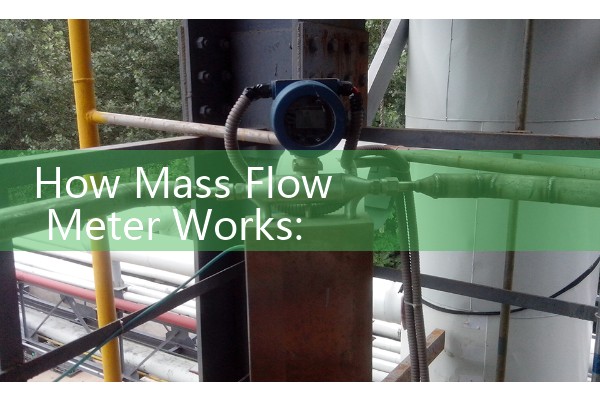
How Mass Flow Meter Works: True Density and Temperature Multi-Variable Output
Quick Answer: A Coriolis mass flow meter measures mass directly from tube twist caused by fluid inertia. The same sensor reports true density from tube resonant frequency and fluid temperature from an internal PT100 element. One transmitter can send mass flow, volumetric flow, density, temperature, and often concentration on 4-20 mA HART.
Direct Mass Flow Measurement, Not Volume Compensation
Many flow meters measure volume first. A turbine meter counts pulses. A magnetic flow meter reads velocity. A differential pressure meter reads a square root. Then the control system has to apply pressure, temperature, or density compensation. That step adds error and takes time.
A Coriolis mass flow meter skips that step. The meter reads mass flow directly. No extra pressure or temperature input is needed to calculate mass. This is the main reason engineers choose a Coriolis meter for batching, filling, and custody transfer.
In practice, mass flow is what the process usually cares about. A tank can be filled in kg. A reactor can be charged with a set mass. A diesel engine can be monitored by fuel consumption in kg/h. Volume alone does not tell you the mass unless density is stable.
How the Coriolis Tube Reacts to Mass Flow
A Coriolis meter drives one or two tubes at a natural frequency. An electromagnetic coil makes the tube vibrate. When fluid moves through the vibrating tube, inertia produces a small twist. The inlet side and outlet side move out of phase.
Two sensors, one on each side of the tube, measure the time delay between the two sides. The time delay is proportional to mass flow rate. This measurement is fast, often updating 50 to 100 times per second.
Here is the thing. The tube does not care if the fluid is gas, water, paste, or resin. It measures mass. No moving parts touch the fluid. No bearings. No internal seals.
True Density Output from Tube Frequency
The same tube has a resonant frequency. The frequency changes with the total mass inside the tube. Since the tube volume is fixed, the frequency tells you the fluid density directly. The transmitter converts that frequency into a density reading in kg/m³ or g/cm³.
This means the meter is not just a flow meter. It is also a density meter. If a food plant pumps a syrup with batch to batch density changes, the meter reports it every second. No separate sampling line. No separate density analyzer.
Most engineers skip this part. They only wire the mass flow output. Then they leave the density and temperature outputs unused. Those signals are already inside the transmitter. You paid for them.
Temperature Measurement as a Built-In Corrective Signal
An internal PT100 element sits in the tube wall. It measures fluid temperature through the metal. Accuracy is usually around ±1 °C or better. The transmitter uses this signal to correct the tube stiffness value because metal stiffness changes with temperature.
The temperature signal is also available as a third output. This is useful for product quality checks, heat exchanger monitoring, or simple batch logging. You do not need a separate thermowell or RTD insertion point.
We have seen this on customer sites many times. A dye maker in Thailand used the temperature output from a DN15 Coriolis meter to check the batch temperature during a filling cycle. That saved one extra sensor in a small mobile skid.
Multivariable Output Wiring: One Device, Three to Five Signals
 >A typical Coriolis transmitter can deliver several signals at once. Channel 1 sends mass flow on 4-20 mA HART. Channel 2 sends density on 4-20 mA. Channel 3 sends temperature on 4-20 mA. A pulse output gives totalized mass in kg.
Some models also include RS485 Modbus RTU. This lets the PLC read all values in one cable. Wiring is simple: signal, power, and ground. Less cable, fewer glands, fewer I/O cards.
The density output is true density, not calculated density from a pressure and temperature compensation table. This matters for emulsions, slurries, and non-Newtonian fluids.
Where This Saves Time and Money in Real Plants
A palm oil exporter in Indonesia installed a DN40 Coriolis meter on a filling line. They needed mass flow, density, and temperature for each batch. One meter replaced three separate instruments. The HART loop sent kg/h, kg/m³, and °C to the PLC. The plant reduced pipe penetrations and spare parts.
Last year a customer in Vietnam asked us about a resin line at 800 cP. The process pressure was 12 bar and the pipe size was DN25. A Coriolis meter worked without a viscosity correction. A turbine meter would have needed a viscosity curve and tighter straight run.
In water and wastewater, a magnetic flow meter works well if conductivity is above 5 µS/cm. But it cannot give density. A Coriolis meter gives mass, density, and temperature even on oily water or sludges. That is why some desalination plants and food factories prefer it for raw material skids.
Model Selection and Data You Need to Send
For a fast quote, send us the following data: fluid name, flow range in kg/h or L/h, operating pressure in bar, temperature in °C, pipe size in DN, connection type, output protocol, and hazardous area class. This is the data our engineers use to size the meter.
Silver Automation Instruments supplies Coriolis mass flow meters from DN10 to DN150. Common configurations include 4-20 mA HART, pulse output, RS485 Modbus, ATEX Zone 1, and remote or integral transmitters. We also supply electromagnetic flow meters, oval gear flow meters, thermal mass flow meters, and pressure transmitters.
Send your pressure, temperature, pipe size, and flow range to our team at Tel: +86-25-68650347 or WhatsApp: +86-25-52155837. You can also reach us on WeChat at +86 15365082610 or visit flow-meter.com.au. Tell us the fluid and the required outputs. We will reply with a model and a quote.
FAQ
Can a mass flow meter measure mass and density at the same time?
Yes. The meter measures mass flow from tube twist and density from tube frequency. Both values are available on separate outputs.
What is the typical accuracy of a Coriolis mass flow meter?
Many standard models are 0.2% of rate for mass flow and ±1 kg/m³ for density. Some higher accuracy models reach 0.1% for custody transfer. Temperature accuracy is often ±1 °C.
Does the temperature output need a separate sensor?
No. An internal PT100 element measures the tube temperature. The transmitter uses this signal for correction and sends it as an output.
Can a Coriolis meter measure gas, liquid, and slurry?
Yes. Coriolis meters work on gas, liquid, slurry, and paste. Gas measurement is more common at higher pressure and smaller line sizes. Send your gas density and pressure range for sizing.
Which output protocols are available?
4-20 mA HART is the most common. Pulse, RS485 Modbus, and Profibus are often available. Not all models have every option. Send your PLC or control system protocol to confirm.
 Hot Blog
 Related AD