Current position > Product detail
Turbine water flow meter
『Turbine water flow meter』Related information(clamp on meter|electromagnetic meter|venturi meterrotameter|orifice meter|ultrasonic flow meter|mass flow meter|coriolis mass flow meter|coriolis flow meter|magnetic flow meter|magmeter flow meter|magflow flow meter|mag meter flow meter|electromagnetic flow meter|vortex flow meter|turbine flow meter|thermal mass flow meter|thermal flow meter|rotameter flow meter)

1. Which is more useful for measuring similar water media, such as turbine flow meters, vortex street flow meters, or electromagnetic flow meters The advantages of electromagnetic flowmeter are minimal pressure loss and a wide range of measurable flow rates. The ratio of maximum flow rate to minimum flow rate is generally above 20:1, suitable for a wide range of industrial pipe diameters, up to 3m. The output signal is linear with the measured flow rate, with high accuracy. It can measure the fluid flow rate of acid, alkali, salt solutions, water, sewage, corrosive liquids, as well as mud, slurry, pulp, etc. with conductivity ≥ 5 μ s/cm. But it cannot measure the flow of gas, steam, and purified water. When a conductor cuts magnetic field lines in a magnetic field, an induced potential is generated in the conductor, and the magnitude of the induced potential is proportional to the effective length of the conductor in the magnetic field and the speed at which the conductor moves perpendicular to the direction of the magnetic field. Similarly, when a conductive fluid flows vertically in a magnetic field and cuts magnetic induction lines, it will also generate induced potentials on the electrodes on both sides of the pipeline. The turbine flowmeter consists of a turbine, bearings, preamplifier, and display instrument. The principle of a turbine flowmeter is to place a turbine in the center of a pipeline, supported by bearings at both ends. When the fluid passes through the pipeline, it impacts the turbine blades, generating a driving torque for the turbine, which overcomes the friction torque and fluid resistance torque to produce rotation. Within a certain flow range, for a certain viscosity of the fluid medium, the ro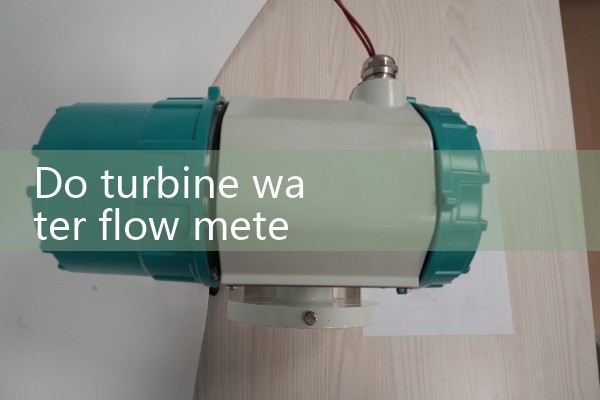 tational angular velocity of the turbine is proportional to the fluid flow velocity. Therefore, the fluid flow velocity can be obtained from the rotational angular velocity of the turbine, and the fluid flow rate through the pipeline can be calculated. The rotational speed of the turbine is detected by a sensing coil installed outside the casing. When the turbine blades cut the magnetic field lines generated by the permanent magnetic steel inside the casing, it will cause changes in the magnetic flux in the sensing coil. The sensing coil sends the detected periodic change signal of the magnetic flux to the front stage. An amplifier that amplifies and shapes signals, Generate a pulse signal proportional to the flow rate, send it to the unit conversion and flow accumulation circuit to obtain and display the accumulated flow value; At the same time, the pulse signal is also sent to the frequency current conversion circuit, which converts the pulse signal into an analog current and indicates the instantaneous flow rate value. The measured fluid impacts the turbine blades, causing the turbine to rotate. The speed of the turbine changes with the change of flow rate, that is, when the flow rate is high, the speed of the turbine is also high. Then, the speed of the turbine is converted into electrical pulses of corresponding frequency by the magneto electric conversion device. After amplification by the preamplifier, it is sent to the display instrument for counting and display. The instantaneous flow rate and cumulative flow rate can be calculated based on the number of pulses and cumulative pulses per unit time. The working principle of a turbine transmitter is that when the fluid flows along the axis of the pipeline and impac
『SILVER Official Website SERVICE』
User:flowmeasurementdevicesa695dLast Time:07/10/2026